
Mining and resources identity and endpoint hardening
Conditional access, MFA and Defender for Endpoint rolled out across exploration and operations users, closing the gaps a resources supply-chain questionnaire tests for.
Read the case studyMycelium 365 Modern Workplace managed IT support starts from $147/user/month — covering helpdesk, device management, Microsoft 365 administration, Security as a Service (SOC), and cyber awareness training. No per-incident charges. Licensing is not included. View our packages →
Mycelium 365 provides IT support and managed IT services to Perth and Western Australian businesses across the metropolitan area and regional WA. Our IT support covers helpdesk, device management, cybersecurity monitoring, Microsoft 365, and Azure — all under a fixed monthly managed IT agreement. Unlike break-fix IT support, our managed service is proactive: we monitor your environment 24/7 and resolve issues before they affect your team. Explore managed IT support across Australia →
Mycelium 365 is a Microsoft-only managed service provider whose Western Australian accounts are led from WA by Samuel Rowe, with a national engineering team behind him working remote-first on AWST hours. On-site support is available in Perth within a few hours and in regional WA within 48 hours. We own your Microsoft 365 tenant, identity, devices and Azure workloads, watch them 24/7, and produce the supply-chain evidence WA resources and government contracts demand — at a fixed per-user price.
Mycelium 365 provides IT relocation services in Perth and across Western Australia. The service covers internet provisioning, network and Wi-Fi deployment, workstation and infrastructure relocation, Microsoft 365 validation and move-day support.
Read more on modern workplace and managed IT services for Perth businesses.
Looking for the best Microsoft 365 partners in Perth? See our guide to choosing the right WA Microsoft partner.
For a broader look at how a Microsoft Solutions Partner MSP covers WA, see our guide to managed IT services for Perth businesses across Perth and regional Western Australia.
Support aligned to AWST business hours rather than eastern-states ones, with critical incidents acknowledged inside 15 minutes and monitoring running around the clock.
Tenant configuration and written evidence that clears operator prequalification portals and vendor assurance questionnaires instead of stalling in them.
Maturity assessed honestly, gaps costed, and the ASD Essential Eight controls implemented in Microsoft 365 rather than described in a policy document.
Mycelium 365 provides managed IT support for Perth businesses — Microsoft 365 helpdesk, Intune device management, Defender security monitoring, and Azure infrastructure for Western Australian businesses. Support operates 8am–6pm AEST (6am–4pm AWST) with after-hours escalation for critical incidents. On-site IT support available in Perth CBD on request.
Read our managed Microsoft 365 guide for full details on what's included.
Mycelium 365 provides Microsoft 365 consulting for Perth businesses — tenant assessments, licence optimisation, Intune device management reviews, SharePoint governance, and Copilot readiness. Consulting engagements are delivered remotely on AWST hours, beginning with a structured review of your current Microsoft 365 environment. For Perth businesses looking for ongoing managed IT rather than one-off consulting, Mycelium 365 provides fixed-price managed IT from $147/user/month — covering Microsoft 365 management, Intune, Defender for Business, Essential Eight controls, and unlimited helpdesk with no per-incident charges. Book a Perth discovery call or call +61 1300 116 418.
Almost every national provider says it "covers" Perth. The verifiable difference here is a named person who lives and works in Western Australia, whose role, photograph, profile page and LinkedIn are all published so you can check before you call.
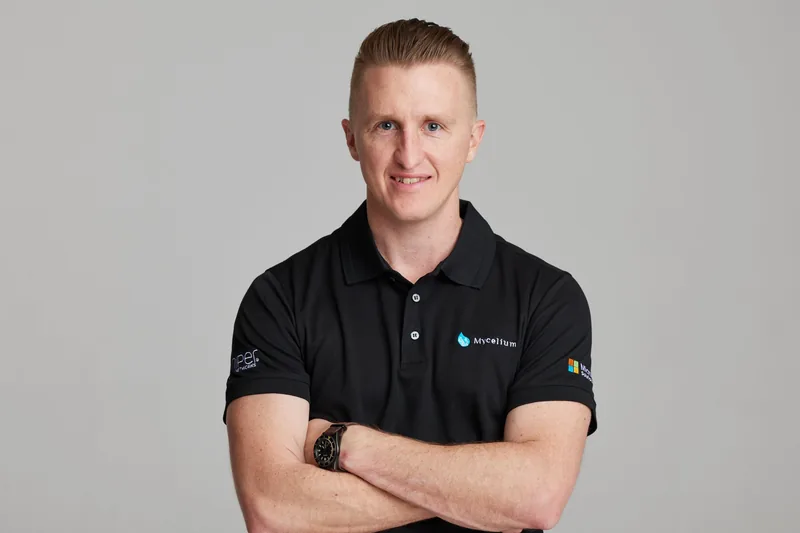
Western Australia is led by Samuel Rowe, who is based in WA rather than visiting it. He is our Operations Manager and state manager for Western Australia and South Australia, and he is a real person you can look up before you call us — profile, role and LinkedIn are all linked here for exactly that reason.
Sam's 15 years as an Information Systems Commander in the Australian Army shaped a service desk philosophy built on accountability — problems are owned, not passed around. His approach to helpdesk management is the single biggest driver of positive client feedback at Mycelium 365.
For clients, this means a service desk culture where issues are logged, owned, and resolved — not escalated in circles. In practice that means the person accountable for your service starts the day when you do. A problem raised first thing in the west is owned in the west, not held until an eastern-states desk opens, and an escalation has a name and a face attached rather than a queue reference. The same person is answerable for whether the underlying fault is still there next month.
Samuel is also the continuity in the relationship. He is in the discovery call, the onboarding, the quarterly review and the awkward conversation when something has gone wrong — which is not how most national providers staff a WA account.
Credentials and the wider leadership team are on our senior management page, and how the business started is set out in our story.
Western Australian technology estates tend to be shaped by two forces the eastern states feel less: distance, and customer-driven assurance. Distance puts users on constrained links at sites hundreds or thousands of kilometres from head office. Assurance means your largest customers audit you. Both are engineering problems, and both are solved in the platform rather than by adding headcount.
Tenant administration, Exchange Online hygiene, SharePoint structures that survive joint ventures, and licence positions reconciled against roster movements rather than an out-of-date headcount spreadsheet.
Windows, macOS, iOS and rugged Android under one compliance policy — including shared site devices, warehouse scanners and field tablets that never touch a corporate network.
Latency-sensitive engineering, accounting and design applications hosted next to their data, so a remote site sends screen updates instead of dragging multi-gigabyte files across a satellite link.
Microsoft Defender across endpoint, email and identity with a Huntress-powered managed SOC behind it — human-led detection through the AWST evening, when eastern-states-only providers have gone home.
Conditional access, privileged identity management and guest governance for the joint-venture and contractor accounts that accumulate quietly in every resources-sector tenant.
Tested recovery for Microsoft 365 data and Azure workloads, with restore evidence you can hand to an auditor or an insurer — not a backup job nobody has attempted to reverse.
Tier inclusions and pricing sit on our packages page. WA businesses facing a customer audit usually begin with the Essential Eight baseline audit so the gap list is factual before anyone commits to a remediation budget.
Western Australia's business base is unusually concentrated. Resources and the industries that serve them dominate, the port drives a freight and broking economy at Fremantle, and the professional firms in West Perth and Subiaco largely exist to advise the first two. That concentration shapes every technology conversation we have here.
Explorers, contract miners and the corporate offices behind them. The dominant technical constraint is bandwidth and intermittency: crews work rosters at remote sites on satellite or microwave links, so OneDrive sync behaviour, Teams call quality and offline file access matter more than they do in a CBD-only business. Tenants are built for roster-based accounts, low-bandwidth Teams policies, and strict separation between corporate data and joint-venture data shared with partners.
Fabrication, maintenance, drilling and labour-hire firms that hold contracts with the large operators. These businesses are audited by their customers, not by a regulator — prequalification portals ask for evidence of multi-factor authentication, patching, backup and incident response before a purchase order is issued. We provide the tenant configuration and the written evidence that closes those questionnaires.
Fremantle-linked freight forwarders, customs brokers and transport operators running EDI integrations, shift-based shared logins and warehouse scanners. The pattern we standardise is Microsoft Entra ID shared-device sign-in, Intune-managed rugged Android handhelds, and mailbox rules that stop invoice-redirection fraud on a high-volume accounts payable function.
Geologists, corporate advisers, accountants and legal practices concentrated in West Perth and Subiaco, many of them acting for listed juniors. Continuous-disclosure and market-sensitive material drives the controls: Purview sensitivity labels on announcement drafts, external-sharing restrictions on deal SharePoint sites, and privileged access limited to time-bound roles.
Mycelium 365 supports Perth businesses across the full metropolitan area and regional WA — from the West Perth CBD and inner west through to the southern suburbs and outer metro. Common locations we support:
West Perth, Perth CBD, Subiaco, Leederville, Nedlands, Shenton Park, Jolimont, Wembley
Fremantle, Cockburn Central, Jandakot, Cannington, Maddington, Thornlie, Kenwick, Southern River, Huntingdale, North Lake
Osborne Park, Joondalup, Malaga, Balcatta
We support resources and logistics businesses across Karratha, Port Hedland, Newman, Kalgoorlie, and Bunbury remotely, with on-site visits coordinated from Perth.
All Perth and WA support runs on AWST hours — no east coast lag. On-site support is available across the Perth metro within a few hours. Book a WA discovery call or call +61 1300 116 418.
Two forces set the security bar in Western Australia, and neither is a regulator knocking on your door. The first is government: Western Australian public sector entities operate under the cyber security policy maintained by the Office of Digital Government, and organisations that supply or are funded by those entities routinely inherit equivalent expectations through contract terms. The second is commercial: the large resources operators run supplier assurance programmes that function like a private regulator, and failing one costs you the contract far faster than a compliance finding ever would.
Both ask for the same underlying evidence, which is why we build to one control set and reuse it. Multi-factor authentication everywhere including service and break-glass accounts, application and operating system patching on a measurable cadence, administrative privileges restricted and time-bound, application control and macro settings enforced through Intune, and backups whose restores have actually been attempted. That is the ASD Essential Eight, and it is the language WA prequalification portals speak.
Where a business handles personal information at scale, the Privacy Act and the Notifiable Data Breaches scheme apply as they do nationally, and the logging we retain exists so the notifiable-or-not assessment can be made from evidence rather than guesswork. Insurers ask similar questions at renewal, and our cyber insurance controls review answers those in the insurer's own terms.
Resources and WA Government supply chains audit their vendors as well as their own estates, so the question of how we secure our own operation comes up early in Perth procurement. Our own information security management system is certified to ISO/IEC 27001:2022 (QAS International, certificate AIT1045), covering the managed IT, cloud, cybersecurity and helpdesk services we deliver to clients. See our certifications.
Your account is led from Western Australia by Samuel Rowe; the engineering team behind it is national and works remote-first on AWST hours. Everything that can be delivered remotely is — identity, mailboxes, devices, tenant configuration, security response — and that covers the overwhelming majority of the work. On-site support is available in Perth within a few hours and in regional WA within 48 hours when physical work genuinely requires it. The precincts below describe what we see across the WA metropolitan area, and each links to a page written for that area.
St Georges Terrace and the West Perth resources corporate corridor — junior explorers, corporate offices of contract miners, and the corporate advisers attached to them. Small head-count tenancies with disproportionate data sensitivity: board papers, drilling results and market-sensitive announcements.
Showroom, wholesale, trades and engineering-services businesses along the Mitchell Freeway spine, most of them running a mixed estate of desktops, field tablets and a stubborn on-premise application.
Freight forwarders, customs brokers, marine services and stevedoring-adjacent firms whose operational systems talk to port and carrier platforms, and whose staff work shifts rather than nine to five.
Canning Vale, Armadale and Gosnells — fabrication, transport yards, mining-services workshops and family-owned trade businesses where a large share of the workforce never sits at a desk.
Moving a WA business onto the platform is a project rather than a support ticket, and Microsoft 365 migration in Perth sets out how those run. Every area we publish is listed on the national Microsoft and IT support.
Clients on a managed plan see up to a 95% reduction in IT support tickets. That number comes from removing recurring faults — standardised device builds, enforced patching, clean identity, no configuration drift — rather than from closing tickets faster. It is the metric we would want to see if we were buying this service.
The work is published rather than described. A mining and resources security uplift and a manufacturing Azure Virtual Desktop rollout are the closest matches to a typical WA brief, and every case study states the starting position, the change and the cost. Our Microsoft Solutions Partner credentials are independently verified by Microsoft against delivered outcomes, not self-declared.

Two engagements that match how Western Australian operators actually run: hardened identity for a resources firm, and remote-site access without a legacy VPN.
Conditional access, MFA and Defender for Endpoint rolled out across exploration and operations users, closing the gaps a resources supply-chain questionnaire tests for.
Read the case studyField and plant users moved onto brokered virtual desktops, removing the VPN concentrator and giving remote sites a consistent session over poor links.
Read the case studyMycelium 365 supports Perth and Western Australian businesses as a Microsoft Solutions Partner MSP — led from WA on AWST hours, delivered remote-first, with on-site support available in Perth within a few hours and in regional WA within 48 hours. Fixed per-user pricing and no lock-in contracts make budgeting simple for resources, logistics and corporate WA. Compare tiers on our packages page.
Samuel Rowe runs Western Australian engagements, and the first conversation is with an engineer inside AWST hours — not a hand-off to an eastern-states queue the next morning. Thirty minutes is enough to walk your tenant, your remote and FIFO sites and the identity controls a resources supply-chain questionnaire asks about, and to say plainly what is exposed. Call +61 1300 116 418 or email sales@mycelium365.com.au.
Book a WA discovery call